
Electromagnetic Pumps with Signal Control
ML Series
Solenoid metering pump with manual control
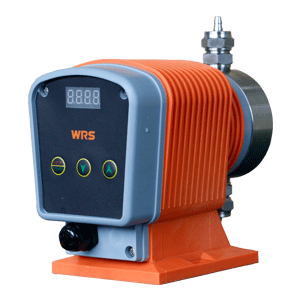
- Flow rate: 1–20 L/h
- Pressure: 10–1 bar
- Materials: PVC / PVDF / SS304 / SS316
- Flow control: Manual
MLS Series
Solenoid metering pump with automatic control
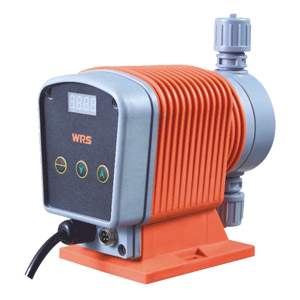
- Flow rate: 1–20 L/h
- Pressure: 10–1 bar
- Materials: PVC / PVDF / SS304 / SS316
- Flow control: Pulse / 4–20 mA control signal
What is a metering pump with electromagnetic drive?
A metering pump, also widely known as a dosing pump or chemical injection pump, belongs to the family of positive displacement piston pumps. The primary function of a metering pump is to accurately dose chemicals into a system. There are various types of metering pumps, including solenoid, piston, peristaltic, diaphragm, and hydraulic pumps. The ML & ML‑S metering pumps are solenoid‑driven pumps with microprocessor control.How does it work?
In an electromagnetic metering pump, an electromagnetic drive moves the diaphragm in a reciprocating motion within the pump head, causing changes in volume and pressure inside the pump chamber. Pressure changes, driven by the opening and closing of suction and discharge valves, enable precise intake and discharge of liquid. A magnet moves the solenoid valve shaft back and forth, turning it on and off. This motion is transferred to the diaphragm in the metering head. Two check valves prevent backflow of chemicals during pumping. Additionally, stroke length and speed can be adjusted to modify the pump’s performance.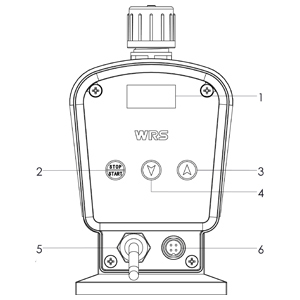
1. Frequency indicator, 2. Start/Stop button, 3. Increase button, 4. Decrease button, 5. Power cable, 6. Signal plug (only for ML‑S)
Difference between ML and MLS Series
The main difference between the ML and MLS series lies in their ability to connect to a control signal source. The MLS model includes an additional connector for pulse or 4–20 mA signals, while the ML model does not have such a connector. Otherwise, all parameters are identical.Common Applications
- Drinking water treatment: Disinfectant dosing
- Cooling circuits: Corrosion inhibitor and biocide dosing
- Wastewater treatment: Flocculant dosing
- Paper industry: Additive dosing
- Plastic manufacturing: Additive dosing
Key Advantages
Since there is only one moving part, the drive is virtually wear‑resistant. The pump does not require lubrication of bearings or shafts, resulting in very low maintenance and repair costs. It also offers excellent continuous operation performance.Technical Specifications
| Parameter | Value |
|---|---|
| Flow rate range | 1–20 L/h |
| Pressure range | 10–1 bar |
| Operating temperature (fluid) | –15 ℃ to 60 ℃ |
| Viscosity range | 0.3–1000 cps |
| Ambient temperature range | –10 ℃ to +45 ℃ |
| Power consumption | 28 W |
| Supply voltage | 1Ph 240V 50Hz / 1Ph 110V 60Hz |
| Strokes per minute | 80–180 |
| Diaphragm diameter | 60–84 mm |
| Protection rating | IP55 |
| Control options | Manual (ML), Pulse/4–20 mA (MLS) |
| Diaphragm material | PTFE + EPDM rubber + SUS304 + Nylon fiber |
| Valve type | Ball check valves |
| Suction lift | Up to 2 m |
Installation and Operation Guidelines
- Mounting: Can be installed vertically or horizontally using provided brackets.
- Tubing: Use compatible chemical-resistant tubing (supplied: suction 4 m, delivery 2 m).
- Priming: Ensure the pump is primed before initial operation to avoid dry running.
- Maintenance: Regularly inspect diaphragm and valves for wear; clean suction filter periodically.
- Safety: Install in a well-ventilated area away from direct sunlight and rain (unless outdoor-rated).
Optional Accessories
Backflow Preventers
Protects against reverse fluid flow in the system.
Strainers
Removes particulates from fluid to protect pump.
Pulsation Dampeners
Reduces pressure fluctuations in the delivery line.
Flow Meters
Monitors actual flow rate for precise dosing control.
Level Sensors
Automates pump operation based on fluid levels.
Why Choose Our Solenoid Metering Pumps?
Precision Dosing
Accurate ±1% flow control ensures reliable chemical dosing.
Low Maintenance
Single moving part design minimizes wear and service needs.
Flexible Control
Manual or automated operation with multiple signal options.